Nathan Simmons is a Brisbane based filmmaker. He is currently in his second year at University and runs a production company known as Salty Dog Media. Recently, he was the show runner for the horror web series The Pallidura. After watching Episode 4, I was amazed at how well crafted and scary this series is. It will definitely be an amazing horror web series that I am very excited for. Read on for more.
What is the Pallidura?
Nathan on set
“It is a story about a couple – Curtis and Jessica – who are celebrating a birthday. An old friend comes to the party with a mysterious painting and once he enters the party Curtis’s life is never the same.”
What was your big inspirations for this project?
“The idea came in a writing workshop we had. The educator said, think of an object in your home and how it can attract a character. I thought about how some people can have a fascination for a painting and some people can have a hatred for it. The story has evolved from a divorce story where one partner hates it and one loves it to where it is now.”
Throughout the whole process, how do you maintain motivation and a good headspace?
“I never had bad feelings. It’s because I love it and I love making films. I really wanted to make the story as good as it can be. We spent like 50 hours writing it in the writer’s room. It was also a learning opportunity to as well because these ideas came from my head and I had to communicate it with 60 other people.
What are your plans for releasing it?
“60 people worked on this so it would be cruel if people didn’t watch it. We are currently looking at what festivals it can go out to. Obviously, there are a lot of horror festivals it would suit. YouTube would probably be the very last place we would stick it. We might even take the idea to screen Queensland. I wouldn’t mind telling the idea again…”
Isabella Lee, Molly Humphries, Bailey Leis on set
TALKING MOVIES
What specific movies or shows inspired the Pallidura?
“The Babadook was a heavy one. I love the allegory of depression and grief. Oculus was another good one as well. The original idea was inspired by The Ring but I have never seen it, I have seen Scary Movie 3 though. I really like Jordan Peele’s movies, I’m on board for everything he does.
The Babadook
Are there any key writers and directors that inspire you?
“I love Tarantino. I was also watching Breaking Bad and Better Call Saul at the time and it’s where I got a lot of visual style from. Big fan of Spielberg but I didn’t use any of his techniques.”
What scares you personally when you watch horror?
“Not knowing. I hate jump scares and don’t find them scary. I just find them really annoying. I saw SPIRAL and that movie pissed me off because they just relied on loud noises. I also watched Dahmer and that had some terrifying moments, especially where the cops let a victim back in.
What is the worst thing people do at the cinemas?
Charlotte Chaffer-Brock, Nathan Simmons and Jude Buxton on set
“Fucking talk. Shut the fuck up when you watch a movie! I watched Halloween Kills last year and there was these people who kept talking and saying they didn’t find it scary. I can’t stand in, don’t ask me about the plot.”
The Future
Where do you want the Australian film scene to be in 5 years?
“The movies they are making are more aimed at the older target audience. Movies like The Dry and Red Dog are created for that age demographic. I just think there should be movies about a random thing that happens in an Australian city. Like the Matrix was shot in Sydney is a perfect example. Ultimately, they just haven’t hit me as a target audience yet.”
If a film genie came to you with one wish, what would it be?
“I would love to direct a feature. If I was funded, I would love to write, direct and edit a feature and show it in the cinema with my family and friends.”
What’s next for you?
“Salty Dog Media. It’s my new business media company with Chris Radman where we make content for other people and we are open to collaborating with others.”
“Huge thanks to all the students involved in creating the Pallidura. Especially Abbey Rose who helped out as the series coordinator. Everyone should be super proud of what they have done. Can’t wait to show the world what all of us have made.”
When you hear the term “Australian horror” not much usually comes to mind. Maybe Wolf Creek, The Babadook, Rogue and potentially even Picnic at Hanging Rock. And while these films have their merits, I truly believe there is one that constantly flies under the rug. It is a film that I have never stopped talking about since I was 16. A film that Martin Scorsese himself raves about. A film that makes you feel so uneasy and uncomfortable it is almost hard to recommend – Wake in Fright.
Since most people reading this haven’t heard of Wake in Fright, I will give a small recap (I would honestly go watch it first though). Wake in Fright is a horror/ thriller directed by Canadian director Ted Kotcheff. It is about John Grant, an English school teacher living in a small town in 1970s Australia. On the holidays, he attempts to leave the town to visit Sydney. However, he gets stuck in Yabba – a tiny mining town – after gambling and drinking away his money.
Now hearing that may make you think that this film does not belong in the horror genre. But I think that’s exactly what makes it so special. It is not your stereotypical horror story about a killer or monster. Instead, the horror lies in the town, the people, and the situation.
Upon John’s arrival at ‘the Yabba’, it is very clear how much of an influence gambling has over this town. From the two up games to the obsession with the pokies, Kotcheff displays this horrifying hold that gambling has over people. Like a ghost, it possesses this small town and keeps them hooked. And soon enough, it grabs John and takes a complete hold of him. John forgets his ambitions and dreams of making some quick money. But with any gambling addiction, the end is never pretty. John loses all the money he has worked so hard for and can no longer visit his girlfriend.
One of the smartest parts of this movie is the use of climate. In particular, the focus on Australia’s harsh and unforgiving heat. Every scene makes you feel like you are profusely sweating. The sun constantly beating down on our protagonist is draining both on John Grant and us. It effectively makes the audience constantly uncomfortable from the moment this movie starts.
Wake in Fright reveals one of the most fundamental flaws of Australian culture – toxic masculinity. As John starts talking to Jannette, a man around the table says, “he would rather talk to a woman than drink?” Every woman in this movie is either insulted, used for sex, or abused. It reveals to us this dangerous but very realistic misogynistic attitude that exists deep down in Australian culture. A deep-rooted and horrifying perspective of women being inferior.
But perhaps the greatest horror of Wake in Fright is the portrayal of alcoholism. From John’s arrival in Yabba till the end of the film, he is force fed this poison. Declining alcohol in this town is the equivalent of slapping someone in the face. The physical queasiness this had on me was something I don’t often feel in films. It was such an accurate portrayal of the Australian drinking culture that I completely understand why this movie didn’t do well – people don’t want to see the truth. They don’t want to see an outsider expose their country’s biggest faults.
The Yabba is not simply a small outback Australian town. Instead, it is a hell. All these themes display a horrible and dangerous outlook on life. John Grant is trapped in a place that has drained him of any ambitions. A place that has transformed him into what he once hated most. John has been infected with this nihilistic perspective on life. What Kotcheff shows the audience is that this way of life is the horror. These views and substance abuse can lead to a wasted and toxic life, whether you realise it or not.
After years of drama, gossip and rumours Olivia Wilde’s Don’t Worry Darling is finally here. Before the film was even released, it had been trashed for the performances and plot. This can instantly destroy a movie. Audiences go into the cinema jaded by reviews or potentially don’t even see it. So is Don’t Worry Darling as horrible as everyone says? Is Harry Styles’ performance that atrocious?
Don’t Worry Darling is one of the most beautiful looking films of the year. The cinematographer – Mathew Libatique – creates this pristine and elegant world. Every shot has the perfect light that accentuates this idyllic 1950s’ town. While the constant lens’ flares aren’t for me, I am 100% here for the world that he and Olivia Wilde have created.
Beautiful cinematography needs to be coupled with a well-constructed and tight plot. With a run time of 2 hours and 3 minutes, the audience must be kept engaged from the get-go. Unfortunately, I was not. I just found myself kind of bored in this movie. Scenes drag on for way for too long and once you figure out what’s coming, it just feels kind of bland. I know Olivia tried to include some moments to keep you hooked but they just weren’t enough. Ultimately, the beats of this story feel repetitive and dragged out.
What really failed for me in this movie was the horror. I understand it’s meant to be more psychological than physical, but it felt very flat. I cannot even recall some of the sequences because of how forgettable and repetitive it was. It didn’t feel like any new horror was brought to the table but instead just repeating what has been done in cinema for the last 30 years.
Florence Pugh certifies herself as an incredible actress. She is so talented at being scared that if all she did for the next 10 years was horror I wouldn’t mind. On top of this, Florence delivers some dodgy lines excellently. I truly believe she puts this film on her back and carries it to the finish line.
Now the backlash on Harry Styles’ performance is warranted – it’s not great. He isn’t even that bad it’s just that there are so many other talented actors out there who would have smashed this role. It always feels like he is trying to give an Oscar worthy performance by screaming and yelling a lot when it isn’t warranted and doesn’t make sense. In a movie this high budget and high concept, Harry doesn’t belong.
Everyone else is good. Chris Pine replicates this type of Andrew Tate man in a way that I haven’t seen in a film yet (no spoilers). Olivia Wilde shows off her comic abilities and adds this light-hearted touch to the film. Gemma Chan and Nick Kroll were amazing but just not in it enough. With all of Nick’s talents, he should have been in this film much more.
Before I go into spoilers, I want to highlight the soundtrack. John Powell has created a new and refreshing horror movie sound. Every time it played it made me genuinely remember to write about how good the music was. He has blended breathing, humming and music together to create a chilling horror theme that feels very different to everything being made right now.
!!!!SPOILERS!!! (RANT)
The twist in this movie is one of the most predictable and bland pieces of writing I have seen. 15 minutes into this film I had guessed what it was and spent the rest of the film praying it wasn’t that. The problem with Don’t Worry Darling is that the writer and director think they have this Sixth Sense level twist on their hands and spend the whole movie building up to it. But it isn’t. Instead, the audience should have been shown earlier what is going on and the rest of the film should have been her working it out and attempting to escape. Imagine if this film had a similar plot to the Truman Show but really focused on how horrifying and scary this situation is. There could have been stronger ties to abusive relationships and control instead of this washy garbage. There is just so much wasted potential for this high concept idea that really could have been something special.
Should you see it in cinemas?
No, this is definitely a streaming movie. While all the pieces are there, it ultimately just falls flat due to a predictable script. If Harry Styles wasn’t in this film, it would be on Amazon Prime right now.
George Miller is back with his third film in 10 years. Mad Max, Babe, Happy Feet – all critically and financially successful and yet we rarely see his name pop up in the credits. So something big had to be next for Miller. And that ambitious film was none other than Three Thousand Years of Longing. A film so unique and different that it makes complete sense for Miller to direct. But was this film worth his return to directing? Does it live up to the hype of his previous films?
Three Thousand Years of Longing is a romantic / fantasy film written and directed by George Miller. It sees a lonely scholar – Tilda Swinton – who is granted three wishes by a Djinn (Idris Elba).
Every time you go to the cinemas, you kind of know what you are already going to see. Between trailers and marketing, you have a pretty rough idea of what is coming. I was completely blindsided by this film. Three Thousand Years of Longing shocked me from beginning to end and that is for one core reason – the sound design.
I haven’t seen a movie as precise and careful with its use of music and sound in a long time (probably Mad Max actually). Each scene uses it so sparingly that it makes the audience glued to the world in front of them. Even the transitions between locations use natural sound to make the film flow. But what accentuates this creative choice is the writing.
George Miller and Augusta Gore have replaced music with a script that feels like a song. The dialogue has a perfect rhythm that makes this film flow. You almost forget the lack of music when the words spoken by Tilda Swinton and Idris Elba feel poetic. For a film about storytelling, Miller understands exactly what makes a story work. It is not about the visual elements but instead the spoken word and that is exactly why this narration works so well. And while these effects were striking, they were not what made me love this film. Instead, it was the movies core theme.
The emphasis on the importance of storytelling to humanity is a perfect golden thread and something that means a lot to me. Three Thousand Years of Longing not only reminds the audience on why we need stories to survive but also the different forms they can take. It accomplishes this through roughly 6 separate stories each more intriguing and different then the last. With different themes and messages, they will leave any audience wanting to spend more time in the mind of George Miller.
Like a song however, the film ebbs and flows. It did have moments where I lost interest and was not completely gripped by the story. I think it comes down to the run time. While an hour and 40 minutes is by no means a long film, I do think it could have been cut down. If this film was 15 minutes shorter, the pacing would have been fantastic. When so much time is spent in one location, it is pivotal that the audience is still hooked by the story and especially the actors.
(Spoilers)
Now I did like the performances of Tilda Swinton and Idris Elba. In fact, I loved them. They both did an excellent job of displaying loneliness and how it affects people in different ways. Also, what stories can mean to people’s lives. Where their performances fell a little flat was in the chemistry. I never felt the love between them. While they bounce off each other well, the sudden turn in the story didn’t make sense for these characters. It felt like a sharp right turn in a direction I didn’t think these George Miller and these actors were going for.
Should you see this film?
Yes absolutely. It is a movie that will sit with you for days on end. Not only is it a completely original story but it is the craft of it that will keep you hooked. However, I do recommend going in expecting a slower pace and a different method to most Hollywood movies.
How does one know thyself? When confronted by the realities of our station in life, how do we respond to them? Will we take advantage of what time we have left to fulfil the passions that burn within us?
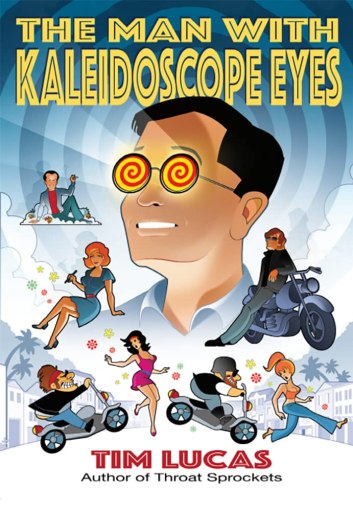
These questions percolated in my mind as I read Tim Lucas’ novel The Man With Kaleidoscope Eyes, a fictionalized account on the making of Roger Corman’s 1967 psychedelic opus The Trip – which first appeared in cinemas on this day 55 years ago.
Cover art by Charlie Largent.
The Subject
Cinemaverick: Corman in his element during the making of The St. Valentine’s DayMassacre (1967).
By the mid-1960s, Roger Corman, a top-tier producer/director for B-movie studio American International Pictures (AIP), had become dissatisfied by the constraints of his series of Edgar Allan Poe adaptations starring Vincent Price. Endeavouring to make films that reflected the controversies of the times, his first attempt at such a movie, The Wild Angels (1966) – a biker drama starring Peter Fonda, Nancy Sinatra, and Bruce Dern – was a major box office success. For its follow-up, Corman turned his attention to a particularly hot-button subject: lysergic acid diethylamide, better known as LSD or acid.
Japanese poster for The Trip.
Directed from a screenplay by a long-time member of Corman’s talent pool, Jack Nicholson – better known today for playing a certain Clown Prince of Crime! – the resulting film, The Trip, follows disillusioned commercial director Paul Groves (Fonda) as he seeks to gain personal insight through an LSD trip: the first of its kind depicted in a motion picture. Guided by his guru friends John (Dern) and Max (Dennis Hopper), Paul witnesses a parade of sensual and terrifying imagery throughout his hallucinogenic odyssey that forces him to consider his place in the world, and especially his relationships with women; he is torn by his feelings for his wife Sally (Susan Strasberg), who he is soon to be divorced from, and Glenn (Salli Sachse), an acquaintance of Max’s with whom he feels a mutual attraction.
Alternately confounding, nauseating, sexy and funny, The Trip remains a thoroughly engrossing watch, marked by its rapid editing and depictions of nudity, both of which were considered ground-breaking for the time. Although its style and subject matter reflect key interests of the hippie movement (LSD was made illegal across the United States soon after its release, and the film’s portrayal of it prompted the British Board of Film Censors to ban the movie for 35 years), the film’s thematic underpinnings still carry weight decades after the Summer of Love. As someone who doesn’t have any experience with such drugs, I was pleased that the film wasn’t an excuse for flashy imagery, and that it grounded the psychedelic experience in human drama through its focus on whether Paul can form personal connections amidst the emotional turmoil of a divorce. Among those The Trip impressed upon its initial release was a young film buff from Cincinnati named Tim Lucas…
The Author
Lucas with his legendary tome Mario Bava: All the Colors of the Dark. To say this guy knows his movies is putting it lightly.
A renowned film critic/historian with fifty years of professional writing experience, Lucas is best known for co-publishing (with his wife Donna) the pioneering home media review magazine Video Watchdog (1990-2017), and for writing the celebrated critical biography Mario Bava: All the Colors of the Dark (2007). He has provided audio commentaries on the DVD and Blu-ray releases of over 100 movies, covering not only most of Bava’s films and several of Corman’s, but works by directors as varied as Jean-Luc Godard, Alfred Hitchcock, Sergio Leone and Orson Welles. Lucas has also penned three published novels: Throat Sprockets (1994), The Book of Renfield: A Gospel of Dracula (2005) and The Secret Life of Love Songs (2021). A throughline that connects Lucas’ work is his focus on our capacity for experiencing and expressing love for each other. This is an appropriate motif, given the themes of Corman’s film and the story he has weaved about its creation.
In 2003, Lucas began writing a comical screenplay about the making of The Trip with his friend, writer/artist Charlie Largent. Their story was structured around Corman’s revelation that, despite not outwardly fitting in with the counterculture of the period, he prepared for the film by undergoing an LSD trip on the beaches of Big Sur, California, surrounded by colleagues who witnessed and recorded his observations.
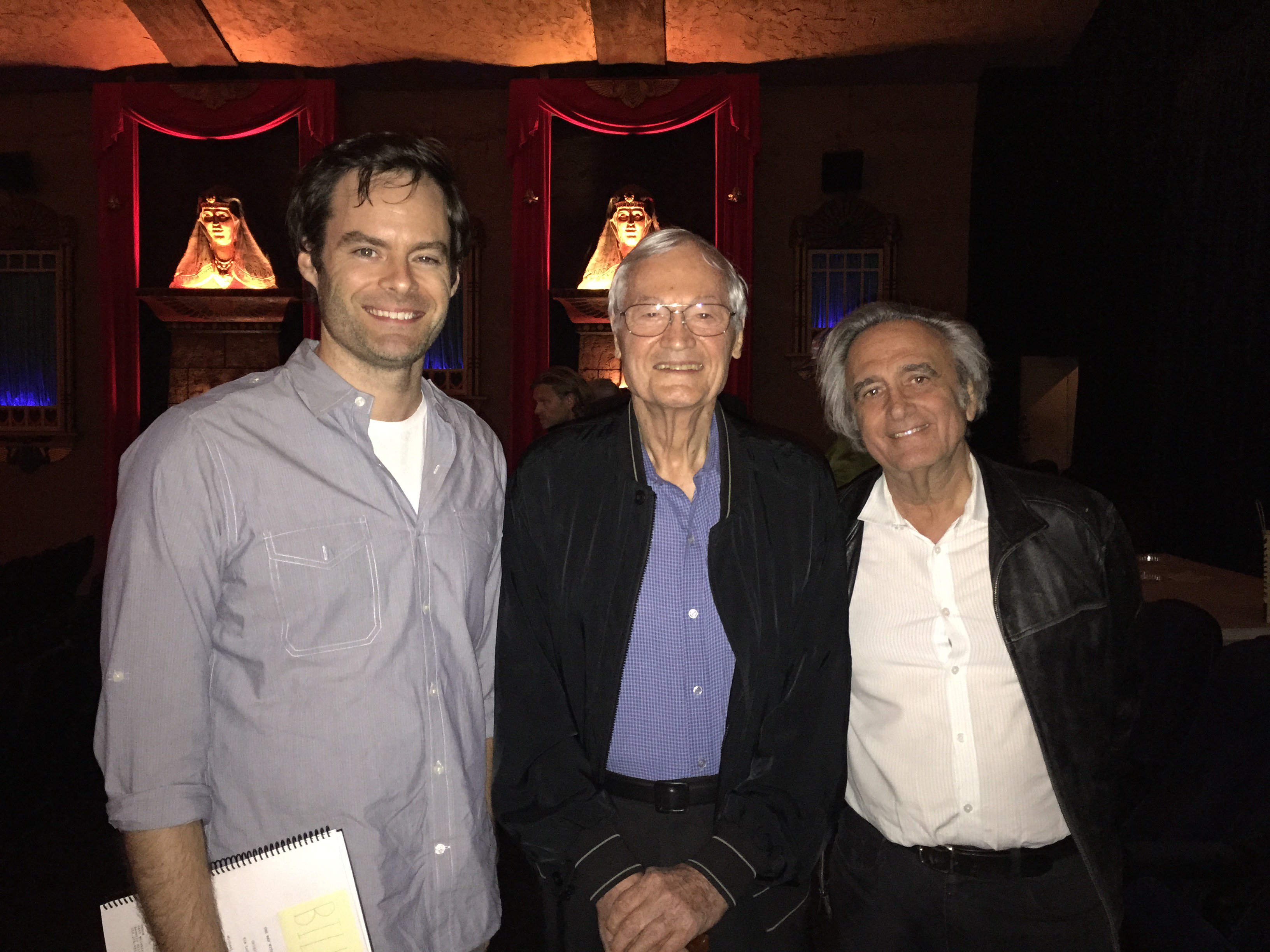
Bill Hader, Corman and Joe Dante at the 2017 script-reading of The Man With Kaleidoscope Eyes.
Although The Man With Kaleidoscope Eyes was soon optioned by Corman’s protégé, Gremlins (1985) director Joe Dante, and it is set to be co-produced by SpectreVision (Elijah Wood’s production company), the film has yet to see the light of day. The closest the project has come to being actualized was a 2017 script-reading at the Vista Theater in Los Angeles, billed as “The Greatest Film Never Made”; reviews of the reading unanimously praised Bill Hader’s portrayal of Corman. These aborted attempts to make the movie inspired Lucas to rewrite Kaleidoscope Eyes as a novel, drawing on correspondence with Corman’s wife/producing partner Julie, and his long-time assistant Frances Doel, to expand the story beyond what was in the script, which by this time had undergone several revisions, including contributions from writers Michael Almereyda and James Robison.
Commentary
My personal collection of Lucas’ first three novels.
Lucas’ earlier novels are characterised by their unconventional approach to narrative structure. Primarily written from the first-person point of view of the protagonists, they frequently take unexpected turns into other modes of writing, including transcripts of film scenes and interviews (Throat Sprockets);diary entries, letters and commentaries written by characters years after the referenced events (The Book of Renfield, in the style of Bram Stoker’s Dracula); and songs (The Secret Life of Love Songs).
The Man With Kaleidoscope Eyes continues this trend, albeit to a lesser extent than its forebears, by presenting its first four chapters out of chronological order, with chapter titles indicating the month and year in which the events take place: the story begins in November 1966, with Peter being awed by Jack’s script for The Trip, before flashing back five months earlier to Roger in the throes of post-production on The Wild Angels. It diverges from Lucas’ previous works by being his first novel to be largely written in a narratorial third-person style, with its only ventures into first-person occurring in Chapter 11, which chronicles Roger’s trip. As a reading experience, I would describe Kaleidoscope Eyes as Lucas’ most accessible novel, and appropriately his most cinematic.
The picturesque beaches of Big Sur, where Roger partook in his trip, became a major location for The Trip.
As with his earlier books, Lucas demonstrates meticulous attention to detail: his vivid overview of the changing cultural landscape in mid-60s Hollywood in Chapter 2 (which he describes as “the Summer of Foreplay before the Summer of Love”) infuses the location with a sense of excitement, where anything is possible and change is the law of the land. His imagination is on full throttle in his renderings of Roger’s trip, which are appropriately thoughtful yet bizarre. Consider the passage where Roger’s musings over the grains of sand that comprise Big Sur’s beach evolve into the observation that “God was a surfer”.
My personal copy of Reynold Brown’s poster art for X: The Man with the X-Ray Eyes.
Given the setting, comparisons to Quentin Tarantino’s Once Upon a Time in Hollywood (2019) and its 2021 novelization are inevitable (Lucas has revealed that Tarantino was among the first to read Kaleidoscope Eyes’ script, and quickly voiced his desire to play the role of Roger’s friend, screenwriter Chuck Griffith). Like Once Upon a Time in Hollywood, which revels in its tributes to classic Hollywood TV shows, movies and Spaghetti Westerns, Kaleidoscope Eyes is full of references to Corman’s other films. These include his civil rights-themed drama The Intruder (1962) – the commercial failure of which makes Roger hesitant to make more “personal” films – and X: The Man with the X-Ray Eyes (1963), the poster art for which helps him devise an on-the-spot pitch for The Trip to his AIP bosses Sam Arkoff and Jim Nicholson.
Chuck Griffith about to meet his demise at the jaws of Audrey Jr. in The Little Shop of Horrors – a little movie that has left a large legacy.
I also spotted several funny references to The Little Shop of Horrors (1960): when Chuck tries to buy LSD from a dealer at Venice Beach, the dealer promises “Lots plants cheap”, a verbatim reference to a sign on Mushnick the florist’s wall, and Audrey Jr.’s catchphrase “FEED ME!” rears its head during Roger’s trip. The book is also packed with period detail (such as Metrecal, a predecessor to Sustagen that Roger drinks), and references to the music of such artists as Herb Alpert (“Spanish Flea”). As with the call-backs to Roger’s movies, these might throw off a reader unfamiliar with them, but Lucas’ fast pace allows 60s novices to get back on track to the heart of the narrative.
A scene from Corman’s pseudo-Poe film The Terror (1963) – described by Lucas as a “sorry-assed picture” – featuring Jack Nicholson and his then-wife Sandra Knight.
An advantage of the novel’s third-person approach can be seen in Lucas’ fleshing-out of the book’s cast. With a few exceptions, the supporting characters of his other novels tend to be abstract, in part due to the often-egotistical perspectives of the protagonists. Here, most of Roger’s friends and colleagues are clearly-defined, likable creatives who you want to see achieve success. Peter is a wide-eyed dreamer who wants to carve a legacy of his own, rather than simply being “Hank’s boy”. Jack is a hardworking, emotive artist who is frustrated by the bad hand life has dealt him thus far – his divorce from actress Sandra Knight inspires Paul and Sally’s split – but is determined to reward Roger’s friendship and trust.
Lucas gives Frances Doel (pictured in 2011), an overlooked member of Corman’s team, a chance to shine.
Appropriate given her background and Oxford education, Frances is very much the Alfred to Roger’s Batman, a sounding board as much as she is a faithful assistant. Chuck – who recalls Harry Connick Jr.’s portrayal of Dean McCoppin in The Iron Giant (1999) – is a cool beatnik who happily guides Roger through his trip despite his initial 600-page script for The Trip being discarded in favour of Jack’s more streamlined take. Another of Roger’s protégés, Peter Bogdanovich – whose directorial debut Targets (1968) is prominently foreshadowed by Lucas – is a sharp-witted dandy keen to make the leap from critic to filmmaker. In their brief scenes, Bruce and Dennis are intellectual, curious thespians eager to give Roger their best work in their performances as John and Max, and while he does not turn her into a fully-fledged character, Lucas offers a nice appreciation of Salli and her portrayal of Glenn.
The Man With Kaleidoscope Eyes and Once Upon a Time in Hollywoodshare much in common, but both are reflective of their authors.
Whereas Lucas’ previous novels can be described as ranging between melancholic or tragic in tone, Kaleidoscope Eyes is the first to demonstrate his lighter side, imparting a sense of optimism that shines through the darkness. It shares a view with Once Upon a Time in Hollywood that, as long as you have friends in your corner and take risks, you can clear the hurdles Hollywood puts in your way.
What about Roger himself? Given the book’s generally light tone and its loving tributes to several celebrated talents, it might have been easy to make him an amiable everyman, a vehicle through which the story unfolds, but Lucas turns the maverick moviemaker into arguably his most complex protagonist yet.
Paul directs a commercial in The Trip. While Corman has admitted that Paul is something of a semi-autobiographical vehicle, Lucas demonstrates they aren’t one and the same.
In his audio commentary for Corman’s The Pit and the Pendulum (1961), Lucas notes that the heroes of many of the director’s films are truth-seekers. This is an attribute that also describes the leads of Lucas’ prior novels, and one which he applies to Roger, whose persona is defined by his incongruities: he has the dress-sense of an old fogey, the mind of a businessman, the heart of an explorer and the soul of an artist. Despite his personal tastes not lining up with those of his younger hippie colleagues, he is determined to accurately portray the psychedelic experience with as much realism as possible in the confines of a low budget, consulting Chuck and Jack about their experiences with LSD and extensively reading the works of such proponents of the drug as Dr. Timothy Leary in preparation for his trip and the film informed by it. Roger’s various faculties come into play in not only how he conducts his work – he views himself as a problem-solver who wants to work out “how to turn $300,000 into several millions” – but his love life.
Peter Fonda and Salli Sachse relaxing behind the scenes of The Trip. The relationship between their characters reflects the “real-life” drama Lucas reveals to us.
Reading through Lucas’ books, I have been struck by his consistent focus on the relationships between his main characters and the women in their lives. His stories cover a wide spectrum of how men interact with “the fairer sex”, including seeking a partner with mutual erotic interests (Throat Sprockets); experiencing the pain of unrequited love and the danger of seduction (The Book of Renfield); and discovering the duality between spouses and muses (The Secret Life of Love Songs). Here, Roger is depicted as a 40-year-old serial monogamist; although courteous and deeply attracted to women (“The Earth is a woman… and I am HUMPING HER!” he screams during his trip), he has trouble allowing them to embrace his multifaceted makeup. Despite having three different girlfriends over the course of the story, Roger’s behaviour is carefully portrayed by Lucas as not creepy or predatory, but indicative of someone who ends relationships as soon as it is clear they are not long-term.
Mr. and Mrs. Corman (pictured in 2010) – a co-production five decades in the making.
Paralleling Paul’s conflicted feelings for Glenn in The Trip, Roger is unsure about the deepness of his friendship with Julie Halloran, a researcher who shares his passion for problem-solving. He deliberately falls out of contact with her while preparing for the movie, fearing that she would not approve of his own “research”. The manner in which Lucas resolves this will-they-won’t-they dynamic not only does justice to the climax of The Trip, but the union they would eventually share together.
Lucas delivers two symbolic masterstrokes during Roger’s trip, which serve to convey his attitude to life: the constant, heightened ticking of his watch, and a “journey” into a giant rabbit-hole covered by screens showcasing every movie that has been, and will be, made. Unlike Paul, who is subconsciously ashamed of the commercialism of his chosen profession, Roger (in both the story and real life) has always embraced the artistic and commercial aspects of filmmaking. His determination to take advantage of what time he has left (in typically punctual fashion for Roger, his trip ends ahead of schedule!) has led him to not only push boundaries in his own movies, but also foster promising talents who might not have otherwise gotten the big break they needed. Indeed, numerous graduates of Roger’s informal “film school” would go on to become Oscar winners, including Bogdanovich, Francis Ford Coppola, Martin Scorsese, Ron Howard, Jonathan Demme and James Cameron.
“Art + business”: Corman seals a deal with Ron Howard for the latter’s directorial debut, Grand Theft Auto (1977).
And the ending? Well, although you can already find out about it online (Dante has already shot part of it as a form of “insurance”, and Ozploitation legend Brian Trenchard-Smith has told me that he was involved as a stand-in), I encourage you to discover its power – it’s a provocative capper that’ll leave you with those burning questions I asked at the start of this deep dive. Without giving too much away, it also neatly harkens back to both the ending of The Book of Renfield, and a phrase Roger may (or may not?) have uttered towards the end of his trip. This line, in turn, is a reference to a phrase claimed by Stephen King to have been uttered by Ray Milland’s character in an unedited version of the ending to X: The Man with the X-Ray Eyes…
A fun, hauntingly beautiful tribute to one of the great craftsmen of the film industry and the power of his work, The Man With Kaleidoscope Eyes earns my highest recommendation. I only hope it’s a matter of time before the rest of the movie version is made…
Oh, no! The author of this article accidentally dropped acid before taking this selfie… now he thinks there’s a bunch of go-go girls dancing to the tune of “Tomorrow Never Knows” within the camera lens!
If you have been to any film festival in Brisbane, you will have seen Sam Monaghan’s face. AISLE 4, Follow that Taxi, It’s Christmas, Heist, Copperpillar, A Werewolf in Byron Bay – these are some of the many short films and web series Sam as acted in. On top of this, he is in Cheeky Moon’s upcoming web series It’s a Cult, is one third of HIRED GOONS and has been in Thor Ragnorak and Aquaman. Please do yourself a favour and watch some of these shorts at the bottom of this article.
Recently, I had the pleasure to go over to Sam’s house and have a chat. We dived into his career, his goals, all about film and in particular, the Australian film scene. It was one of the best conversations about this chaotic industry I have ever had. What was so refreshing was that Sam didn’t bullshit me. Unlike a lot of people in this industry, he told me how challenging this life truly is. But ultimately, Sam’s passion for film was always there. While it may have dipped, the love always came back stronger than ever. Read on for more.
A Brief Introduction
FRAZIER: Can you just introduce who you are and your many roles.
SAM: I feel like I am introducing myself from Hitchikers Guide – resident of planet earth…
I consider myself first and foremost a creative person. I love to act, enjoy writing and have done a whole bunch of other roles so I can do those things (producing, directing).
FRAZIER: So you produce to act essentially?
SAM: There’s not a lot of opportunities to act in Brisbane so you got to make your own work. You get to have a lot of fun and write some stupid roles like Half man half caterpillar.
FRAZIER: What is hired goons – for people who don’t know?
SAM: Hired Goons is a film production company. It was started before I joined by Pearce Hoskinson and Tim Goodwin who are very amazing creatives themselves. They started it in 2017 and the goal was to do corporate work to fund creative work. I joined in 2018/2019 just when their growth hit so I will say it’s a correlation not a causation. We used all that money – much to my wife’s dismay – to make stupid comedy films.
The Hired Goons team
FRAZIER: So, you had a career before film?
SAM: I left well-paying jobs to come do this. My wife didn’t marry into that when we were dating. I kind of just got fatter and more creative. But she’s highly supportive.
Sam’s Film Journey
SAM: I will kind of tell you the journey I have been on if you like?
FRAZIER: Yeah absolutely.
SAM: Back in 2014, my Mum had a big car accident. She was in a coma for about 4 months and in hospital for a year and a bit. I was doing this job I didn’t really care for. I thought “oh man, you could really die tomorrow.” Pretty cliché, but it was a wakeup call. I knew I wanted to do film and came in super bright eyed, and bushy tailed to the industry.
SAM: I was like 25 and all the other 25-year-olds were so jaded from auditioning for so long. I kept thinking “what are you guys upset about you get to do this!” Because of that, I had this energy at the start and was booking stuff. They were just sitting there waiting for the phone to ring and I was like “go make stuff.” I went through all that until I was jaded like them and burnt out…
SAM: Since then, I am now taking a long-term approach to my film and creative work. I have met some of the most creatively talented people who have been doing this work for 30-40 years and they are still striving. While it doesn’t sound inspirational or like any of the self-help books you read, the reality is that some of the most talented people never make a sustainable career out of their creativity. My goal is to have a fulfilling life while working on my creative outlets.
Sam Monaghan and Gabriel Stolz in It’s Christmas
The Process
FRAZIER: Your comedic timing in your body of work is excellent and so noticeably good. But has it improved over time or were you always like that?
SAM: I haven’t done any formal training. I did one semester of film at university when I first went. I think I have always had a natural inclination for timing and comedy. I used it in my family when I was growing up to diffuse a lot of tension which made me good at it. Weaponised comedy has been my approach to life outside of film. I use it to disarm people, test people, charm people.
FRAZIER: Can you dive into the Follow that Taxi feature film?
SAM: So Follow that Taxi, Peirce wrote into a feature film. We were lined up to shoot that in March. We raised an exceptional amount of money. You think, it’s just two people talking in a taxi and I then I read it and it was probably one of the best screenplays I have ever read. It was full of heart, hilarious, good rhythm, we cast it and produced it. And then, covid…. We looked at rescheduling it but we never knew when it was ending.
FRAZIER: What separates a good director versus a shit one for you in terms of talking with actors?
SAM: I think the very first thing you should do as a director, particularly if you have written it, is let go of your ideas. As soon as you get there, you got to let it go and see what they bring. It could be so much better then what you were thinking. Never direct an actor before they have done a take as well. And always let me improvise. You can cut it out later but you just got to let me get it out of my system.
FRAZIER: On that note, what separates a big Hollywood set versus an indie film. Excluding the money and budget?
SAM: I think it’s the same with any big business, the bigger you get the more care you lose. When you are an indie, you can be very nimble and adaptive. I was an extra on Thor Ragnarök. It was a weird experience. We were there for 6-8 weeks everyday which is unheard of.
FRAZIER: 6-8 weeks as an extra!?!
SAM: We were reshooting these group scenes constantly. I just think there’s more opportunities when you have more resources but having two much resource can limit your creativity.
FRAZIER: When you are first reading a script, what do you look for?
SAM: I want to see that someone understands plot, makes sense, the characters have real motivations. It’s not just meandering for no reason. On the other side, if it’s a sketch it just needs to be fuckin funny man. It must make me laugh and think that’s funny.
What’s next?
SAM: I have written a short that I am going to direct and put together in the next few months. It is absurd. It’s one of my favourite scripts because of how dumb it is. It is such a waste of people’s time.
FRAZIER: Is that how you are going to get them in? “It’s a waste of your time”
SAM: Well… it’s about an oom-pah Loompa who gets diagnosed with diabetes. It’s just tragic and straight. There’s a lot of puns in the first scene but it’s just funny because it’s so sad. I even had a friend graciously make me an entire miniature oompah Loompa set out of paper Mache. She took a year and a half to do it..
Sam Monaghan on A Werewolf in Australia
FRAZIER: Holy fuck.
SAM: Yeah, it was a crazy amount of work, but it looks sick.
FRAZIER: So, it’s got to win an oscar now.
SAM: Yep… I am also in a couple of short films coming up. I just did It’s a Cult with Cheeky Moon.
FRAZIER: Oh yeah, I recently did an interview with them. Can you talk about working on that set with Alastair and Claire a little?
SAM: Alastair and Claire are two of the most incredible people I have ever met. That’s it, that’s all I have to say… Nah, it was such a delight because I came from being exhausted and burnt out from film work. It’s a Cult came, and it was so refreshing. It is just beautiful. It’s heartfelt and funny. I got to be a bit straighter and more serious.
FRAZIER: I was talking to Cheeky Moon about your comedy skills, and they were saying how incredible you were as a dramatic actor. Especially some really challenging scenes.
SAM: Well that’s what I found so exciting about it because I had been stuck in Comedy for so long. My character in this show had real feelings. I got to focus on the moment and being a part of something so moving.
FRAZIER: In terms of working with directors, who is your dream person to work with or project to get off the ground?
SAM: To start with, I would make the Follow that Taxi Feature film because that was such a blow and I need that closure. I would love to work with Ricky Gervais and Robin Williams I would die to work with. I would have to now as well. What is the right answer though?
OLYMPUS DIGITAL CAMERA
FRAZIER: Fuck it’s a hard question aye.
SAM: Yeah told you ya prick.
FRAZIER: Probably Edgar Wright though…
SAM: Oh fuck yeah that’s definitely the right answer. Hot Fuzz is probably my favourite comedy as well.
FRAZIER: Or Martin McDonagh. He is my favourite writer.
SAM: Oh my god of course! Best writer for sure.
The Brisbane Film Scene
FRAZIER: This is always a challenging one, but where do you want to see the Brisbane film scene move. Even if you just change it or just progress it.
SAM: A long time ago, I was passionate about it. I always thought, I am going to change this place. Hired Goons goals was to showcase the talent here. Now that I am old and jaded, I don’t give a fuck about Brisbane.
FRAZIER: Hahahaha. See I am like you were before you were jaded.
SAM: You will get their kid, you are just a boy… But I would still love to see it grow and expand. If I ever do get traditionally successful, I will never forget Brisbane. I would love to come back and do indie projects.
Make sure to go check out Sam’s short films below. Whether he is acting, directing or producing, they are truly some of the most entertaining and hilarious productions I have ever seen.
Diving movies have always been done poorly. They have these one-dimensional stories, cheap budgets and almost always focus on a fake looking shark. I truly believe there is so much untapped potential here. Imagine a psychological thriller focusing on a single man diving to the depths of the ocean. A man who is slowly losing his mind – unsure what he is seeing down below. Then, I heard of the Underwater Welder…
If you haven’t heard of this book, let me give you a brief summary.
The Underwater Welder is a graphic novel written by Jeff Lemire. It focuses on Jack Joseph – an oil rig repairer off the coast of Nova Scotia. As he dives deeper and deeper, he pulls further further away from his wife and unborn son. Slowly, we learn about Jack’s past as mysterious and supernatural events start happening on the ocean floor.
This graphic novel is one of the most emotionally complex and moving pieces I have ever read. It explores some deep (ignore the pun) themes like grief, regret, birth, death, and fear. On top of this, it has this perfect mystery that made me finish the whole novel in one night. The Underwater Welder is the definition of a page turner and doesn’t resort to cheap tactics like some authors (Dan Brown, J.K Rowling I am looking at you). It keeps you glued to the book because of the characters not because of a lazy plot.
I know there is this boomer perception that graphic novels are for kids or just cheap imitations of books, but this novel proves how fucking stupid that is. It uses the art to display how lonely and dark our main characters life truly is. A man so filled with grief and fear he is trapped in a haunting and depressing world. Even the transitions are simply perfect. The book has this beautiful flow that feel as if you are watching the events right in front of you. Simply put, you can see the care and passion Lemire has put into each frame of this novel.
Rumours of a Film
In March 2017, it was reported by deadline that Ryan Gosling (from films such as Remember the Titans and uhhh… yeah that’s about it) and Ken Kao (Producer of the Nice Guys, Mid 90s and the Favourite) were bringing the Underwater Welder to the big screen. Since then, we have not seen or heard anything about this film so I can only assume its dead in the water (I know, another pun…). So as per usual, let me give you the 44clovers version of this novel.
The 44 Clovers Pitch
The Underwater Welder would be an incredible psychological horror / drama. For me, the ideal run time would be around 90 minutes, so it doesn’t drag.
Writing it
The novel’s core story has to be kept the same. To respect Jeff Lamire, it has to focus on a blue collared character, grief and the fear of birth. All these elements already work so it shouldn’t be too hard. In my head, the film is a Western set on a coastal town (I know that sounds weird). Imagine No Country for Old Men or Hell or High Water but underwater. I think this is imperative to accentuate how horrible and depressing this town truly is. Also, I like how quiet these films are and their slow but delicate pacing.
The diving
As with the book, the diving scenes need to show how isolated Jack truly is. I would shoot the underwater scenes as if he is in space, a dark and harrowing landscape surrounding him. The lighting would be very simple to really highlight the nothingness around him. Everything must be done physically, or it just won’t work. Similar to Jaws or 13 Lives, I truly believe this film only works if it feels as real and dangerous as possible. A perfect example is Top Gun or Mission Impossible. The stunts have this incredible effect on the audience where you on the edge of your seat because you know it’s real. Imagine how horrifying seeing someone at the depths of the ocean in would truly be. Exactly
Horror
The film would need to focus more on the psychological horror then the book. I love the elements of him slowly loosing his mind and blacking out but feel this needs to be expanded. I think he should go on 3 dives and each one he is slowly seeing more shit. The watch, his father’s body, a diving mask etc etc. Each item getting more and more horrifying. As the film moves forward, it keeps building up until the audience is questioning if he is completely sane. Think Lighthouse, It Follows, I’m Thinking of Ending Things.
The Actors
I would cast Sam Rockwell as Jack Joseph. I know he has done Moon and it is similar, but I think he would be perfect for this role. He has this scruffy chaotic attitude in films like the Way Way Back and Jojo Rabbit I think he can tap into very well. While I never love actors doing dramatic weight changes, I do think it is important he looks kind of scrawny and drained all the time.
Sam Rockwell being a Dad
For his father – Sam Elliot, he is built for this role (the moustache helps). Finally, his wife. I think Toni Collete would be perfect. On top of being an incredible actress, she always has a tired look that matches the wife perfectly.
The Soundtrack
Daniel Hart as always. My favourite composer right now who I believe can do absolutely any film perfect.
Director / Cinematography
I mean James Cameron would be excellent because of his obsession with the ocean but even in my dreams he is denying it. For my round 2 draft pick, I think Leigh Whannel would be incredible and probably better than James Cameron. His blend of horror and character development in the Invisible Man is perfect for this film. For cinematography, I would take Greig Fraser as my number one pick. I know he is now the biggest cinematographer in the world, but I love the colours and looks of Dune and Batman (plus hes Aussie).
Conclusions
Ultimately, I just think this is a film that hasn’t been made and should be. Since A24 is clearly the best production company in the industry right now, they should buy the rights to this film. It screams A24. The story, the characters, the horror – it is made for them. So hopefully, one day we will see this made and not just through a Hollywood production company but through creators who care.
I know it’s a been a week, but I finally got around to watching Anthony and Joe Russo’s the Grey Man. The action / comedy stars Ryan Gosling, Ana De Armas and Chris Evans playing mercenaries and spies hunting down dark secrets.
I won’t lie when I say I didn’t know this film was happening until it came out. There was no hype, no marketing and no promotion by Netflix. So when it was finally released I was excited to see it. In my head, the film would be similar in style and action to Captain American: the Winter Soldier – an excellent film. But I could not have been more wrong and truthfully, I am still trying to figure out why…
Action
I’m sure in the Russo’s heads the action sequences were cool, but it never felt like there was never any weight or danger to them. What I love about Civil War and the Winter Soldier is those close hand to hand fight scenes. In this film, there is one towards the end that is solid, but the rest are not even on the same level. There is too much focus on big scale expensive sequences rather than the John Wick action we have come to love. Even if you set the action scenes in exotic locations, the choreography still has to be entertaining to watch. In the Grey Man, it simply isn’t.
Casting
Ryan Gosling is severely under-utilised in this movie. He is one of the best actors working today and is given absolutely nothing to work with. There is no dramatic moments for him to sink into and barely any comedy – two things Ryan Gosling is very very good at. Just look at his character in the Nice Guys and Drive. I just do not understand why the script is not more targeted for an actor with his skill and expertise. Nevertheless, he does feel dangerous. His stature and body are effective in showing that this man is a killer. I just wish there was more for him to work with.
Chris Evans is excellent in this movie. He is absolutely going for it and I am 100% here to watch. This movie made me realise how much I miss Chris Evans playing a douchebag and I am glad he is returning to his old form. On the other hand, Ana De Armas was not working. I don’t think it’s her fault, it’s just her character is very one dimensional and flat. She doesn’t really have a personality or even an arc. Once again, a very talented actor wasted.
Julia Butters. Wow, what an actress. Most kids in movies are extremely annoying and trying too hard to be funny but, in this film, she feels like a real kid. Julia does a great job at reacting authentically to the big set pieces around her. Also, she is funny without forcing it.
Cinematography
I don’t ever dive into the cinematography for films unless it’s really good or really bad. The Grey Man’s photography just doesn’t make sense. They have chosen to use drones for what feels like 80% of this movie and it never works. It’s disorientating and weird. On top of this, it completely takes you out of the movie. It’s like whenever films use GoPro footage in movies. For some reason, it just makes the audience disconnect from the world they are watching. I just cannot comprehend who thought this was a good idea.
Weak Script
Ultimately, The Grey Man doesn’t work for one core reason – a poor script. Everything surrounding this film is solid but when the script isn’t there, the movie is never going to be anything. There is no substance or genuine emotion to any of the characters in this movie. We learn a tiny bit about Six but not enough to care about him or the people around him. They just needed to dive into this character more and I would’ve been there. Even the side characters have literally no backstory except that they went to Harvard. The heart of this film is so clearly missing and I don’t know how the Russo’s didn’t see that.
On top of this, this film is tonally all over the place. We have characters being serious for half the film, then at the end they are all suddenly comedians. Modern blockbusters are obsessed with being funny and it’s getting more and more draining. Just write funny characters and serious ones. NOT EVERYONE HAS TO BE FUNNY IN A FILM.
At the end of the day, this film is fucking stacked. Great directors, incredible cast, solid soundtrack and it was released on the biggest streaming platform in the world. Everything is there but due to a weak script, it is just kind of boring. The whole film is dull. Despite an A level roster, I was never really interested in the world the Russo’s create and don’t want to see more of it.
SHOULD YOU WATCH THE GREY MAN?
I almost never say this but you can definitely give this one a miss. While the action was solid, it was never enough to really make me care for this film in any way.
Very few documentaries can really change how you view your life. Sure, you may watch them and think “that’s cool” but it’s near impossible to change someone’s perception on the world around them. Sam and Archie did just that. The Diamond of Sierra Leonne is not just an incredible student film but simply an amazing short film. Abib Kamara Smith’s life story made me so grateful for those around me and so driven to do more with my life. If you haven’t watched it yet, do yourself a favour and click the video below.
Sam Cotton Wong is a freelance photographer and videographer based in Brisbane. Sam specialises in cinematography and music videos. He was the director of this production. Archie Waterson is a writer and producer who is completely dedicated to comedy. He was the producer and writer for this short film.
What is the focus of this documentary?
“The documentary follows the story of Abib Kamara Smith who was originally born in Sierra Leonne. He came to Australia when he was 5 years old. He was adopted into this family called the smiths which had siblings of Archie, Gemma, Isaac, Bailey and Bass and his parents Willie and Anthony. And ultimately the documentary just follows his life from Africa and the struggles along the way.” – Sam
Abib Kamara Smith
Why did you choose to produce this short film, Archie?
“Being a student, I was over doing stuff that wasn’t meaningful or purposeful to me. Taking on this bigger story gave me a lot more passion and I think that’s why it was important to take this story on. The minute Sam told me about Abib’s story, I was hooked. Just imagining seeing it on screen and telling it to the world.” – Archie
Why did you want to tell Abib’s story Sam?
“I have grown up with him. Knowing him and his story is completely different to everything I have heard and in Australia especially. Abib’s whole past, his upbringing and especially how he is now excelling in life. Also, the focus of don’t let your past define you was the universal idea and everyone can relate to this idea.” – Sam
Can you just talk us through the style and shooting of the short?
“When we met up with Abib, he just remembers having this old vintage TV in Africa. We tried to recreate that old TV vintage look as a memory of him watching it as a kid. Also, the floating photos seen were representing Abib’s memories in his head.” – Sam
“We wanted to put a lot of effort into the cinematography. We didn’t want to let it drag. The story was obviously going to carry itself, but it needed to look just as good as it felt. We shot on Super 8 for it. It had a nostalgic feel and, we just wanted to experiment.” – Archie
Adam Potts (DOP), Sam and Abib on set
What were some core inspirations for this documentary?
“Definitely Colin in Black and White. Especially the projector shots, they were a big influence.” – Sam
“Also, another one was …. We were really inspired by the look and how poetic it was. Just the structure and how intriguing it was.” – Archie
Can you talk me through the name a little?
Archie and Adam
“When we were originally pitching the project Abib’s from Sierra Leonne and I just sought of put them together since I am a massive Kanye fan. When I was doing background research, I saw they were the biggest exporter of Blood Diamonds. The overall meaning though is that Abib is the diamond coming out of the ground. Also, giving the Kanye fans a little easter egg as well…” – Archie
Biggest challenge of making an indie documentary?
“We had this three-act structure obviously going in that we knew how we wanted to shape it. But, cutting it to a 5–6-minute documentary from a 36 minute was probably the hardest thing.” – Sam
“Abib had so many different stories you could tell in 6 minutes that it made it so difficult for our editor Cooper and Sam to keep it down. Just finding which leads were the strongest and what to go with.” – Archie
What was the most rewarding part of The Diamond of Sierra Leonne?
Lachlan Wormwell, Abib, Sam, Archie and Adam on set
“Feeling the flame inside of all of us when we were making this thing because it was such a passion project. I felt the happiest I have been years working on this because I knew we were telling this massive story. Also, how good the crew was and how much we cared for Abib’s story. One more thing was the lessons I learnt from Abib as well. The perspective it gives you is second to none. It changed my life and how I look at thing’s day to day.” – Archie
“I remember leaving the interview and just going “Holy fuck.” I knew his story well but it was just so intense. You just look at life a bit different. Also, just watching it on the big screen altogether seeing what we created. We made something special and it’s the best thing I have done.” – Sam
What are your ultimate goals with this project?
“We have sent it to a few festivals, and we are looking to get accepted. Another plan was using it as a proof of concept to create a bigger documentary.” – Archie
“I would love to have a screening with friends and family.” – Sam
Where do you both want to see the Brisbane and Australian film scene move?
“For me, I want to see all of the creative people backing themselves more. Australia wise, I want to see more comedy. I want to one day see an Australian TV comedy show that doesn’t overuse Australian cliches. I want to see Australia being universally funny.” – Archie
Abib Kamara Smith
“I think we need more up and coming people supporting each other. At the end of the day, that’s the future and we are all going to be working together one day.” – Sam
Dream project to get off the ground or collaboration?
“I would love to work on a proper Hollywood / Marvel set just to see how it runs. Just watching from preproduction to postproduction to see the flow of things and how they operate. Secondly, starting my own production company. Even if it’s just a photography studio with editing suites at the back. Just a place where we can meet and work together as a creative industry.” – Sam
“I would want to make a feature film. Also, just working with certain people. I would love to be in a writer’s room with Larry David. Even just a conversation with someone like Taika Waititi. I find him so inspiring as someone who comes from somewhere like Australia and keeps his exact same style.” – Archie
Anyone you want to shoutout?
“Shoutout Abib and his family. It’s not an easy thing to allow people with cameras into your home. Also, the rest of the crew on the doco. Our soundie Lachlan Womrwelll, editor Cooper Huzing and our director of photography Adam Potts.” – Archie
The Crew on set
“Big ups to Archie as well. Just his work ethic and planning it all was crazy.” – Sam
All these incredible black and white photos were shot by Finn Negrello.